Choosing automatic versus manual driving lessons affects your license, confidence, practice options, and DMV goals. Learn which fit is right for you today.
How to Practice Parallel Parking Better
That moment when a car is behind you, another is in front of you, and the curb suddenly looks much closer than it should is exactly why many drivers want to know how to practice parallel parking without panic. The good news is that this is not a talent issue. It is a repetition issue. With the right setup, clear reference points, and a calm process, most drivers improve faster than they expect.
Parallel parking feels stressful because it combines slow-speed steering, distance judgment, mirror use, and timing. If you are a new driver, preparing for a DMV test, or returning to driving after a long break, it helps to treat this as a skill you build in layers. You do not need to start between two expensive cars on a busy street. In fact, that is one of the worst ways to learn.
How to Practice Parallel Parking the Right Way
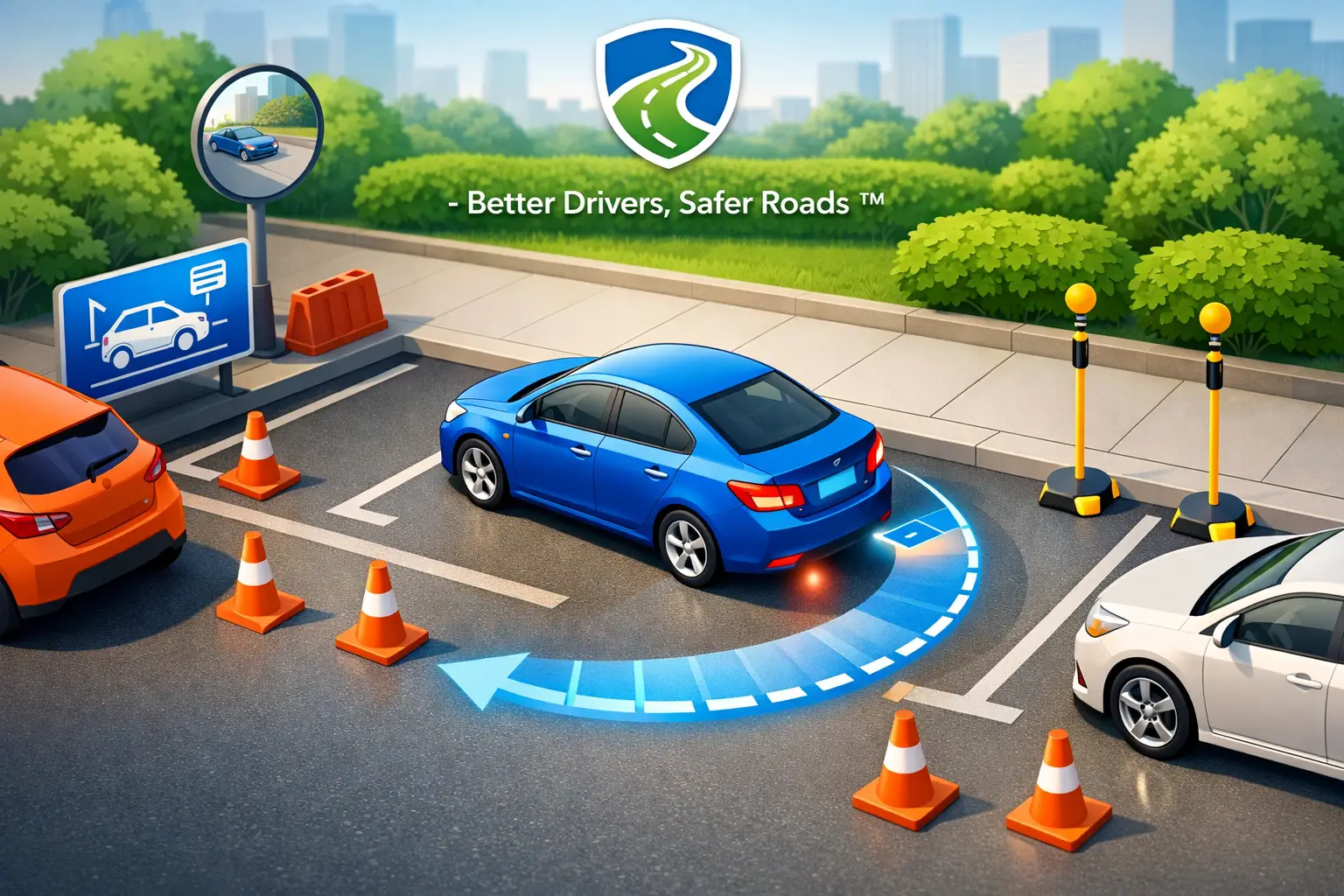
Start in a low-pressure environment. An empty curb on a quiet residential street or a large parking lot with cones is ideal. If you use cones, place them to represent the front and rear cars, then leave a practice space about one and a half times the length of your vehicle. That gives you enough room to understand the angle and steering without adding unnecessary pressure.
Before you move, set your mirrors properly and sit in a driving position that lets you turn comfortably and see clearly. Many parking mistakes begin before the car moves because the driver is sitting too low, too far back, or relying on guesswork instead of visibility. At low speed, small adjustments matter.
Then practice the sequence slowly. Pull up next to the space so your car is parallel with the vehicle or cone in front of it, usually about two to three feet away. Stop with your rear bumpers roughly aligned. Put the car in reverse, check all around for people, bikes, and traffic, and begin backing up slowly.
Turn the wheel toward the curb as you start moving backward. Once the rear of your car enters the space at an angle, pause and check your position. When your front end has cleared the back of the car in front, begin turning the wheel back in the opposite direction to bring the vehicle into the space. Straighten the wheel as needed so the car finishes parallel to the curb.
That is the basic pattern, but the exact timing varies by vehicle. A compact sedan, SUV, and longer vehicle will not all use the same steering points. This is why practice matters more than memorizing one universal formula.
Set Up Practice So It Actually Helps
A lot of frustrated drivers are practicing parallel parking, but not in a way that teaches control. They repeat the same rushed attempt, get nervous, and leave feeling worse. Productive practice should be structured.
First, remove unnecessary variables. Use daylight. Choose a quiet area. Avoid steep hills at the beginning. Turn off music and keep conversation to a minimum. If another person is helping you, ask them to give one instruction at a time rather than a constant stream of corrections.
Second, break the skill into parts. One session can focus only on the starting position. Another can focus on the first turn into the space. Another can focus on finishing close to the curb without touching it. When drivers try to fix everything at once, progress slows down.
Third, repeat the same setup several times in a row. Consistency helps your brain connect what you see with how much steering input is needed. If every attempt starts from a different distance or angle, it is harder to understand what changed.
What to Look At While You Park
Many learners ask whether they should use mirrors, turn their head, or watch backup cameras. The answer is all of the above, with the right balance. A backup camera is a useful tool, but it should not replace basic observation. On a driving test, and in real traffic, you need to show awareness around the entire vehicle.
Use your mirrors to monitor the curb and the cars around you. Turn your head to check blind spots and confirm the path is clear. Glance at the rear window when backing. If your vehicle has a camera, use it as one extra source of information, not as your only source.
The most important habit is to keep scanning. Do not stare at one mirror for too long. A parked car can stay in place, but a pedestrian or cyclist can appear quickly. Parallel parking is a low-speed maneuver, but it still requires full attention.
Common Problems and What Usually Causes Them
If you keep ending up too far from the curb, you are usually turning too late, starting too far away from the parked car, or straightening too early. If you keep getting too close to the curb, you may be turning too sharply or not correcting soon enough.
If the rear of the car goes in but the front sticks out, that often means the second steering adjustment came too late. If you feel like you have to force the car into the space with large last-second corrections, your starting position is probably off.
One more point matters here: pulling forward to adjust is not failure. It is good judgment. Safe drivers make small corrections instead of pretending a bad angle will somehow fix itself. On a DMV road test, controlled adjustment is usually better than hitting the curb or finishing too far out.
How to Practice Parallel Parking for the DMV Test
If your goal is the California road test, your practice should include more than the parking motion itself. Examiners notice observation habits, speed control, signaling, and whether you stay calm and deliberate.
Practice signaling before you pull next to the space. Practice checking mirrors and blind spots in a visible way. Keep your speed very slow and steady. Avoid rolling back quickly or turning the wheel while you are rushing. Smooth control matters.
It also helps to practice with realistic street conditions once your basics are solid. Learn what changes when the curb is painted, when the space is tighter, or when there is mild traffic nearby. But build up to that stage. The best results usually come from starting easy, then increasing difficulty once your technique is repeatable.
For nervous drivers, a professional lesson can save time because an instructor can identify the exact issue. Sometimes it is hand position. Sometimes it is timing. Sometimes it is simply using the wrong visual reference for that vehicle. Personalized coaching often shortens the learning curve because the feedback is immediate and specific.
Practice Tips for Different Drivers
Teen drivers often improve by using a consistent routine and repeating it often enough that it becomes familiar. Adult beginners may need a little more time with spatial judgment, especially if they feel pressure to get it right immediately. International drivers sometimes know how to park well but need to adjust to different vehicle sizes, curb distances, or test expectations in California.
If anxiety is the main issue, shorten your practice sessions. Twenty focused minutes can be more effective than an hour of tense repetition. End on a successful attempt if possible. Confidence grows when practice feels controlled, not overwhelming.
It also helps to say the steps out loud while learning: signal, position, check, reverse slowly, turn in, check, turn out, straighten, adjust. That kind of verbal routine can keep your mind organized when your nerves start to take over.
When to Move From Cones to Real Cars
Cones are excellent for learning angles and reference points because they remove the fear of damaging something. Real cars are better for judgment once you have basic control. The best approach is usually to begin with cones, then progress to a wide real-world space, then tighter spaces after you are comfortable.
There is a trade-off here. If you stay with cones too long, you may avoid the pressure that comes with actual street parking. But if you switch to real cars too early, fear can interfere with learning. Most drivers benefit from a gradual transition.
At Newport Driving School, this is one reason structured behind-the-wheel instruction works so well. Drivers learn the sequence, then practice it with coaching that matches their experience level rather than a one-size-fits-all script.
Parallel parking gets better when you stop treating it like a one-chance test and start treating it like a repeatable routine. Give yourself room to learn, keep your speed slow, and let consistency do the hard work for you.

Related Posts

Comments (0)