Compare California traffic school options, eligibility rules, course formats, and completion steps so you can protect your record with confidence today.
Commercial Learner Permit Help That Works
A commercial permit is not simply a standard driver’s license with a larger vehicle attached. The written tests cover responsibilities that affect passengers, cargo, road safety, and your career. Effective commercial learner permit help turns a large, technical body of material into a clear plan, so you can prepare with purpose instead of repeatedly guessing at practice questions.
For California learners, the goal is to build knowledge you can use before you ever take a commercial vehicle onto the road. That means understanding which tests apply to your intended license, how inspection procedures work, and where a wrong answer may reveal a genuine safety gap.
Start With the Right Commercial License Path
Your permit preparation should match the type of commercial driving you intend to do. A Class A license generally applies to combinations of vehicles, such as a tractor and trailer, while Class B applies to certain single vehicles with a higher gross vehicle weight rating. Some jobs also require endorsements, which can add separate knowledge tests and training requirements.
This distinction matters because studying every available topic is not always the most efficient approach. A learner pursuing local box-truck work may need a different test plan than someone preparing for tractor-trailer operations. Passenger, tank vehicle, doubles/triples, school bus, and hazardous materials privileges each bring additional rules. Requirements can change, so verify the current California DMV requirements for your license class and intended endorsements before scheduling a test.
Many learners feel overwhelmed because the commercial handbook appears to treat every possible vehicle and scenario as equally urgent. It is more productive to identify your target license first, then organize your study time around the general knowledge test, your vehicle class, air brakes if applicable, and the endorsements required for your work.
What Commercial Learner Permit Help Should Cover
Good preparation goes beyond handing you a stack of practice questions. The DMV written exam tests whether you understand the reasoning behind safe commercial operation. Memorization has a place, but it is not enough when questions are worded differently or when you later need to apply the same rule during a pre-trip inspection.
A structured commercial learner permit help program should explain the core subjects in plain language: vehicle inspection, basic control, shifting concepts, space management, hazard awareness, emergency procedures, cargo safety, and alcohol and drug rules. It should also show how those subjects connect. For example, brake checks are not a standalone chapter to memorize. They are part of a larger responsibility to recognize unsafe equipment before operating a vehicle.
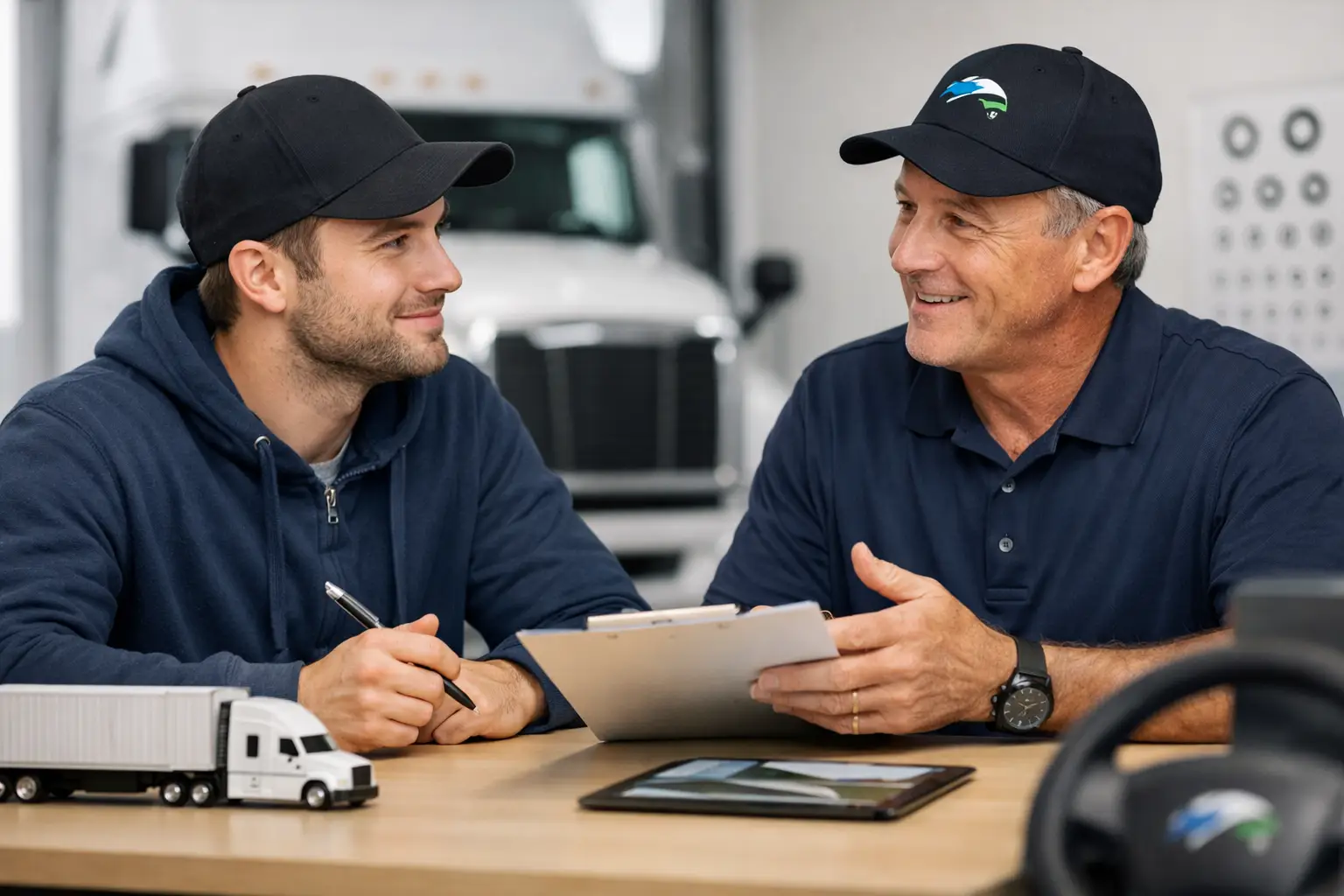
Personal instruction can be particularly useful for adult learners returning to a classroom setting, drivers whose first language is not English, and students who have already missed the permit test once. A patient instructor can identify whether the problem is test anxiety, unfamiliar vocabulary, a weak understanding of air brakes, or rushing through questions. Each issue calls for a different solution.
General Knowledge Is the Foundation
The general knowledge exam is the starting point for most commercial learners. Expect topics that cover defensive driving, communication with other road users, railroad crossings, proper following distance, night driving, skid prevention, and vehicle emergencies.
Commercial drivers need more time and space to react than passenger-car drivers. That simple fact appears in many forms throughout the handbook. A question about downhill speed, a question about wet-road braking, and a question about following distance may all be testing the same judgment: recognize the extra risk early and leave yourself room to respond.
Air Brakes Require Real Understanding
Air brake material is often where learners need the most focused review. The terminology can feel unfamiliar, and test questions may ask about warning devices, pressure loss, brake lag, parking brakes, or inspection procedures. Trying to memorize isolated pressure numbers without understanding the system can lead to confusion.
Study air brakes in sequence. Learn what supplies air, what stores it, what applies the brakes, and what warnings tell you the system may be unsafe. Then connect that knowledge to the inspection process. When the parts make sense as a system, the questions become far less intimidating.
Endorsements Change the Study Plan
Endorsement tests deserve their own preparation time. Tank vehicle questions focus on the special handling issues caused by liquid surge. Passenger and school bus material places added emphasis on loading, unloading, emergency procedures, and protecting people in and around the vehicle. Doubles and triples involve different concerns with coupling, trailer stability, and rearward amplification.
Do not assume an endorsement is a quick add-on because you already passed general knowledge. The responsibility attached to each endorsement is substantial, and the study material reflects that. Give yourself time to understand it rather than treating it as a final hurdle.
Prepare for the DMV Test Without Guesswork
A reliable study routine is usually more effective than a single long cramming session. Set aside focused sessions throughout the week, read the relevant handbook sections, and use practice questions to check understanding. When you miss a question, do not only note the correct answer. Find the rule behind it and explain it in your own words.
Keep a short list of topics that repeatedly cause trouble. If air brake warning systems, cargo securement, or railroad crossing rules keep appearing on that list, revisit those sections before taking more full practice tests. This method prevents a false sense of readiness caused by recognizing answers without fully understanding the material.
Before your appointment, make sure you know what documents and qualifications the DMV requires. Depending on your circumstances and license path, you may need items such as:
- Identity and residency documentation
- Your current driver’s license
- A completed commercial license application
- A medical examiner’s certificate or other required medical documentation
- Any required testing fees or appointment confirmation
The exact paperwork can depend on your driving record, license class, self-certification category, and DMV procedures. Confirm the current list directly with the DMV before you go. Arriving prepared protects your appointment and lets you focus on the exam.
Know the Difference Between Permit Knowledge and Driving Skill
Passing the written tests earns the opportunity to learn under the conditions of a commercial learner’s permit. It does not mean you are ready to operate a commercial vehicle independently or pass the skills test without guided practice.
The next stage typically involves developing three connected skills: a thorough pre-trip inspection, basic vehicle control, and safe on-road driving. The inspection is especially important because it demonstrates that you can identify defects and explain why they matter. In commercial driving, noticing a problem before departure is one of the most valuable safety skills you can develop.
Behind-the-wheel training also exposes the gap between knowing a rule and applying it. Reading about wide turns is different from judging a trailer’s path through an intersection. Studying a safe following distance is different from maintaining it in traffic while managing mirrors, grades, and changing road conditions. That is why permit preparation and practical training work best as parts of one plan.
When One-on-One Instruction Makes Sense
Self-study can work well for a highly organized learner with prior commercial experience. It may be less effective if you have limited study time, struggle with technical test language, or need help identifying exactly why you are missing questions.
One-on-one commercial permit instruction provides structure and accountability. Rather than spending hours reviewing every page equally, you can concentrate on the material tied to your license goal and your weak areas. This approach can also be valuable for learners who are new to California rules or who need instruction paced to their learning style.
Newport Driving School approaches commercial learner preparation with the same patient, safety-focused instruction used across its driver education programs. The objective is not to rush a student through a test. It is to help them build the knowledge and habits that support responsible commercial driving long after the permit is issued.
A commercial license can create meaningful opportunities, but the first step deserves serious preparation. Study the rules, ask questions when a concept does not make sense, and treat every practice question as a safety decision rather than a trivia challenge. That mindset will serve you at the DMV, during training, and in the driver’s seat.

Related Posts


Comments (0)