Senior driving evaluations provide a clear, supportive look at current skills, helping older adults and families make safer decisions behind the wheel.
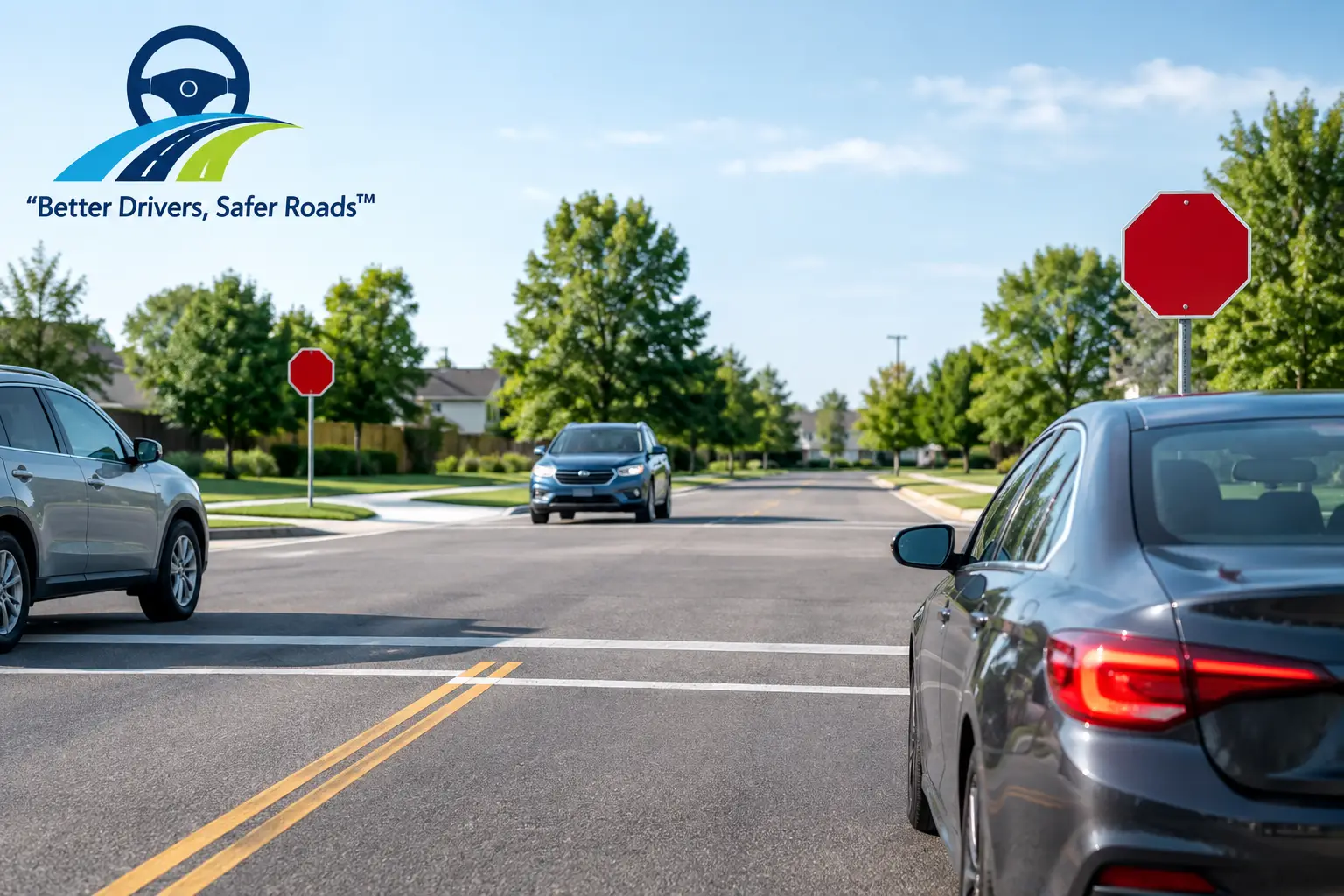
Four Way Stop Procedure and Right of Way
A four-way stop can feel easy until four vehicles arrive within seconds of one another. For new drivers, nervous test-takers, and even experienced motorists, knowing the correct four way stop procedure prevents hesitation, aggressive decisions, and avoidable collisions. The goal is not to rush through the intersection. It is to stop completely, communicate clearly, and move only when the right of way is yours.
Start With a Complete Stop
Every driver must come to a full stop at the limit line, crosswalk, or before entering the intersection if neither marking is visible. A rolling stop does not count. Your vehicle should be fully motionless, even when the intersection appears empty.
This first step matters for more than avoiding a traffic citation. A complete stop gives you time to look for pedestrians, bicyclists, motorcycles, and vehicles that may be approaching faster than expected. At a DMV road test, examiners also watch for whether you stop in the proper location and scan the intersection before moving.
After stopping, look left, right, ahead, and left again. Check crosswalks carefully. A pedestrian already in a crosswalk has the right of way, regardless of which vehicle arrived first.
The Four Way Stop Procedure: Who Goes First?
The basic rule is straightforward: the first vehicle to arrive at the intersection and come to a complete stop is generally the first vehicle allowed to proceed. That driver should move through the intersection promptly when it is safe, without waiting so long that other drivers become unsure of the order.
Real intersections are not always that simple. When two or more vehicles stop at nearly the same time, California right-of-way rules and common safe-driving practice determine what happens next.
When Two Vehicles Arrive at the Same Time
If two vehicles reach the intersection at the same time, the driver on the left yields to the driver on the right. In other words, look to your right. If another vehicle is there and stopped at the same time you did, let that driver go first.
For example, if you are facing north and a vehicle is facing west, that vehicle is on your right. Allow it to proceed before you enter the intersection. Once it has cleared, you may go when the path is open.
This rule gives drivers a predictable way to resolve a tie. It also reduces the risk of two vehicles entering the intersection at once and colliding in the middle.
When Vehicles Face Each Other
Drivers traveling straight from opposite directions can usually proceed at the same time if no pedestrians, cyclists, or turning vehicles are in conflict. The same may be true when both drivers are turning right, depending on the layout of the intersection and the presence of crosswalk users.
A left turn requires more caution. If you are turning left, you must yield to oncoming traffic going straight or turning right. Even if you arrived first, do not begin a left turn in front of a vehicle that is close enough to create a hazard. Right of way does not remove the responsibility to avoid a crash.
When Several Cars Arrive Together
At a busy four-way stop, drivers should proceed in the order they arrived. Think of the intersection as a queue: first stopped, first to go. If cars arrive in a cluster, each driver should watch who stopped first rather than assuming their direction has priority.
If the order is unclear, do not force the issue. Make eye contact only when it is safe to do so, use a brief and predictable pause, and let the other driver proceed if they clearly begin moving. Avoid waving someone through unless you are certain the entire intersection is clear. A friendly hand gesture can be misunderstood, especially when another lane, pedestrian, or cyclist is involved.
Use Signals Before You Reach the Stop Sign
Your turn signal helps other drivers understand your intended path before it is your turn to move. Signal at least 100 feet before turning when practical. At a four-way stop, this is particularly helpful because other drivers are deciding whether your movement may conflict with theirs.
A signal does not give you the right of way. It is a communication tool, not permission to turn. You must still yield as required and wait until the intersection is clear.
If you are going straight, keep your vehicle positioned correctly and avoid drifting toward a turn lane or curb. Clear lane position is another form of communication that helps everyone predict what will happen next.
Watch for the Road Users Drivers Miss Most Often
The vehicle order is only one part of handling a stop-controlled intersection. A safe driver continuously checks for people and smaller road users who may be harder to see.
Pedestrians may step into a crosswalk after you have stopped. Cyclists may travel along the right side of traffic or enter from a bike lane. A motorcycle can be hidden by another vehicle, and a child may move unpredictably near a corner. If your view is blocked by a large vehicle, parked car, landscaping, or glare, ease forward only after stopping and only enough to improve visibility.
Never pull into a crosswalk while waiting for your turn. This blocks pedestrians and can make it harder for drivers on other approaches to see you. If you need a better view, move slowly and remain prepared to stop again.
Common Four-Way Stop Mistakes
Many mistakes at four-way stops are caused by uncertainty rather than poor intentions. Learning to recognize them makes them easier to avoid.
One common error is stopping too far past the limit line. Stop before the line or crosswalk, then creep forward only if necessary to see. Another is following the vehicle ahead too closely. If the car in front of you goes through the intersection, that does not mean you may follow immediately. You need your own complete stop and your own turn in the sequence.
Drivers also get into trouble when they hesitate excessively. Caution is appropriate, but once you know it is your turn and the intersection is clear, proceed decisively. Prolonged hesitation can lead another driver to move at the same time.
Finally, do not rely on another driver’s hand wave as a guarantee that it is safe. That person can yield their own position, but they cannot see every hazard approaching from another direction. Check the full intersection yourself.
Four-Way Stops on a DMV Road Test
A four-way stop is a common place for DMV applicants to lose points because it tests several skills at once: observation, stopping position, right-of-way judgment, signaling, speed control, and decision-making.
During your test, approach at a controlled speed and begin braking early. Stop fully behind the limit line or crosswalk. Scan for pedestrians and cross traffic, identify the arrival order, and move through only when it is safe and legally appropriate.
Do not assume an examiner expects you to be overly passive. Safe driving includes taking your turn when it is yours. If another driver acts unpredictably, yield when necessary to prevent a collision, then continue when the roadway is clear. Safety always comes before insisting on your legal right of way.
What If Another Driver Ignores the Rules?
Not every driver will follow the expected order. Some may roll through the stop sign, accelerate suddenly, fail to signal, or assume they have priority. Your response should be defensive, not confrontational.
Keep enough space to stop, avoid entering the intersection beside a moving vehicle, and be ready to yield if another driver’s actions create danger. Do not try to teach another driver a lesson with your horn, speed, or vehicle position. A brief horn may alert someone who has not seen you, but it should never replace caution.
The four-way stop procedure works best when every driver is predictable. When someone else is not, slow down, reassess, and protect the space around your vehicle.
For students who need extra practice, an experienced instructor can turn these rules into repeatable habits through guided intersection practice. The best result is not simply getting through a four-way stop correctly once. It is developing the calm observation and sound judgment that make every intersection safer.

Related Posts

Comments (0)