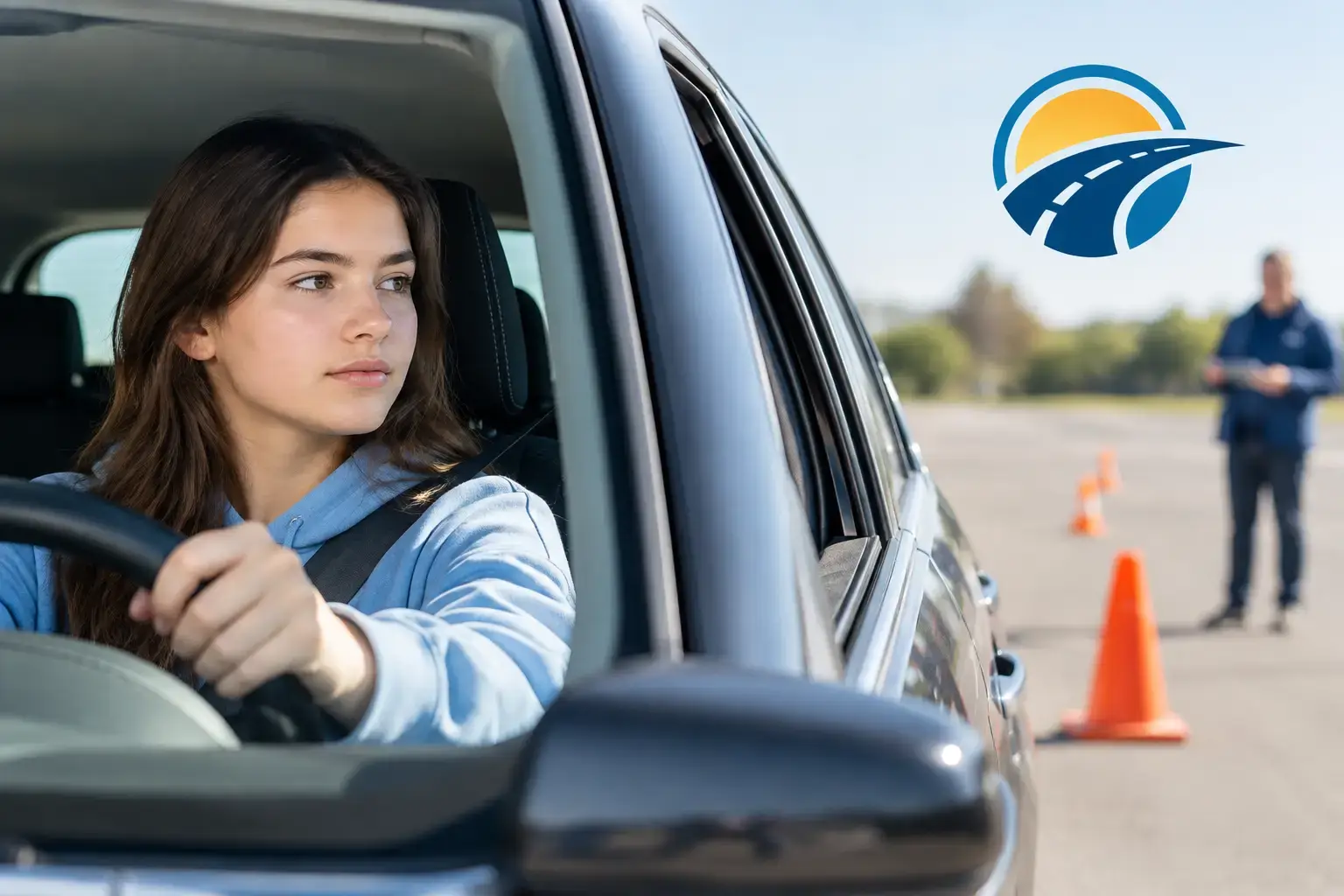
Use this teen hazard recognition training example to help new drivers spot risk early, make safer decisions, and build confidence before the road test.

Parent Guide to California Supervised Driving
A learner’s permit turns the passenger seat into a teaching role, often before a parent feels fully ready for it. This parent guide to California supervised driving helps families turn required practice hours into calm, purposeful experience that prepares a teen for far more than a DMV road test.
Supervised practice is where a new driver learns how real traffic behaves: the driver who changes lanes without signaling, the pedestrian who steps off the curb late, the intersection with limited visibility, and the pressure of making safe decisions while others are waiting. The goal is not to create a driver who merely passes. It is to develop a driver who recognizes risk early and responds responsibly.
Know California’s Supervised Driving Requirements
For most drivers under 18, California requires at least 50 hours of supervised driving practice before they can qualify for a provisional driver’s license. At least 10 of those hours must be completed at night. The teen must also hold an instruction permit for at least six months and complete the state-required driver education and behind-the-wheel training requirements before taking the driving test.
Practice must be supervised by a qualified adult seated close enough to take control of the vehicle if necessary. In general, that supervisor should be at least 25 years old and hold a valid California driver’s license. Parents and guardians are commonly the supervising adults, but another properly licensed adult may help when a family needs additional support.
Requirements and DMV forms can change, so review current California DMV guidance before scheduling the road test. Keep the practice log accurate as you go. Reconstructing dozens of drives from memory at the end of six months is frustrating and can lead to incomplete records.
Start Small, Then Add Real-World Complexity
The most productive early drives are usually not long drives. A new driver benefits more from 25 focused minutes in a quiet neighborhood than an hour spent overwhelmed on a busy road. Begin in an empty parking lot or low-traffic residential area where your teen can become comfortable with steering, braking pressure, lane position, turns, and looking well ahead.
Once basic vehicle control becomes less demanding, gradually introduce more challenging conditions. Practice can progress from familiar streets to busier intersections, multi-lane roads, parking lots, school zones, and freeway entrances. The sequence matters because confidence built too quickly can become overconfidence, while excessive caution can prevent a teen from gaining the experience they need.
A useful question before every drive is: what is the one skill we are working on today? It might be smooth stops, right turns at controlled intersections, scanning before lane changes, or choosing safe gaps. One clear goal helps the supervising parent give useful feedback instead of correcting everything at once.
Build a practice plan around the hours you need
Fifty hours can sound like a large number until a family breaks it into manageable drives. Two or three short drives each week create steady progress without turning practice into a stressful event. Vary the location, traffic level, time of day, and weather when conditions are safe. A teen who practices only on the same sunny neighborhood route may be unprepared for glare, rain, darkness, congestion, or an unfamiliar intersection.
Night practice deserves intentional planning. Begin shortly after sunset on familiar roads, when visibility changes but traffic may still be manageable. As skills improve, include parking, lane changes, turning at intersections, and driving on roads with varied lighting. Night driving is not simply daytime driving with headlights on. Reduced visibility changes how early a driver must scan, judge speed, and identify hazards.
What to Teach During California Supervised Driving
Parents do not need to turn every drive into a lecture. They do need to reinforce habits that protect a new driver when no one is in the passenger seat. Encourage your teen to say what they see and what they plan to do during early practice: “The light is turning yellow, so I’m preparing to stop,” or “There is a cyclist ahead, so I’m checking my mirrors before moving over.” This verbal process makes their observation and decision-making visible.
Focus closely on visual habits. New drivers often look directly in front of the hood rather than far down the road. Teach them to scan ahead, check mirrors regularly, look over the shoulder before changing lanes, and search intersections before proceeding. A green light is permission to move, not proof that every cross-traffic driver will stop.
Space management is another essential skill. A student should learn to leave adequate following distance, slow down before a curve rather than braking through it, and avoid driving beside large vehicles when possible. These choices give a driver time and room to respond to mistakes by others.
Parking should be practiced in real settings, not saved for the final week before the DMV test. Work on pulling into and backing out of parking spaces, curb parking, backing in a straight line, and parking on hills. The test may evaluate specific maneuvers, but parking practice also develops low-speed control, observation, and patience.
How to Give Feedback Without Raising the Stress Level
Even motivated teens can become anxious when a parent gives directions too late, uses a sharp tone, or comments on every small error. The passenger’s calm matters. Give directions early and clearly: “At the next intersection, we will turn right,” is more helpful than, “Turn right now.”
During the drive, reserve urgent instructions for genuine safety concerns. After the car is parked, discuss one or two priorities. Start with what improved, then address the next skill to practice. For example: “Your speed was more consistent today. Next time, let’s work on checking the right mirror before every curbside turn.” Specific feedback is easier to use than “You need to be more careful.”
If emotions rise, it is reasonable to end the drive early. Continuing when either person is frustrated can make the learner associate driving with conflict. A pause is not a setback. It is often the safer choice and gives everyone time to reset.
Avoid taking over every decision
A supervising adult must stay alert and ready to intervene, but constant commands can keep a teen from learning how to think independently. Instead of saying “Brake” at the first sight of a yellow light, ask, “What is your plan for this light?” when there is time for a response. This approach builds judgment while still allowing the parent to step in when safety requires it.
The balance depends on the learner. A very new or anxious driver may need more direct guidance at first. A teen who has built basic control needs more opportunities to make routine decisions, evaluate results, and improve.
Keep the Practice Log Useful
Record each drive promptly with the date, duration, daytime or nighttime classification, and a brief note about the skills practiced. The note does not need to be lengthy. “Heavy traffic, lane changes, and controlled intersections” can help show whether practice is well-rounded.
A meaningful log also helps identify gaps. If most hours are daytime neighborhood driving, schedule more practice on larger roads and after dark. If parking remains difficult after several attempts, devote a separate session to it rather than hoping it improves during general driving.
Do not treat logged hours as the finish line. Some teens are ready to test shortly after meeting the minimum, while others need extra practice to drive safely and consistently in different conditions. More experience is especially valuable when a student still struggles with speed control, lane changes, unprotected turns, or managing distractions.
When Professional Lessons Add Value
Parents provide essential repetition and real-life practice, while professional instructors can provide a neutral assessment and teach techniques that are difficult to explain from the passenger seat. This can be particularly helpful when a teen and parent have reached a communication impasse, when driving anxiety is limiting progress, or when the DMV road test is approaching.
At Newport Driving School, professional behind-the-wheel instruction can complement family practice by identifying specific weaknesses, reinforcing California driving laws, and preparing students for common test situations. A lesson before the road test is most useful when it addresses actual driving habits, not when it is used as a substitute for the required hours of varied supervised experience.
Before the test, take practice seriously but keep the larger purpose in view. A careful, observant teenager who occasionally needs more time is in a better position than a rushed teenager who has completed the log but has not developed sound judgment. Every calm correction, every safely handled intersection, and every extra hour in changing conditions helps build a driver your family can trust.

Related Posts


Comments (0)