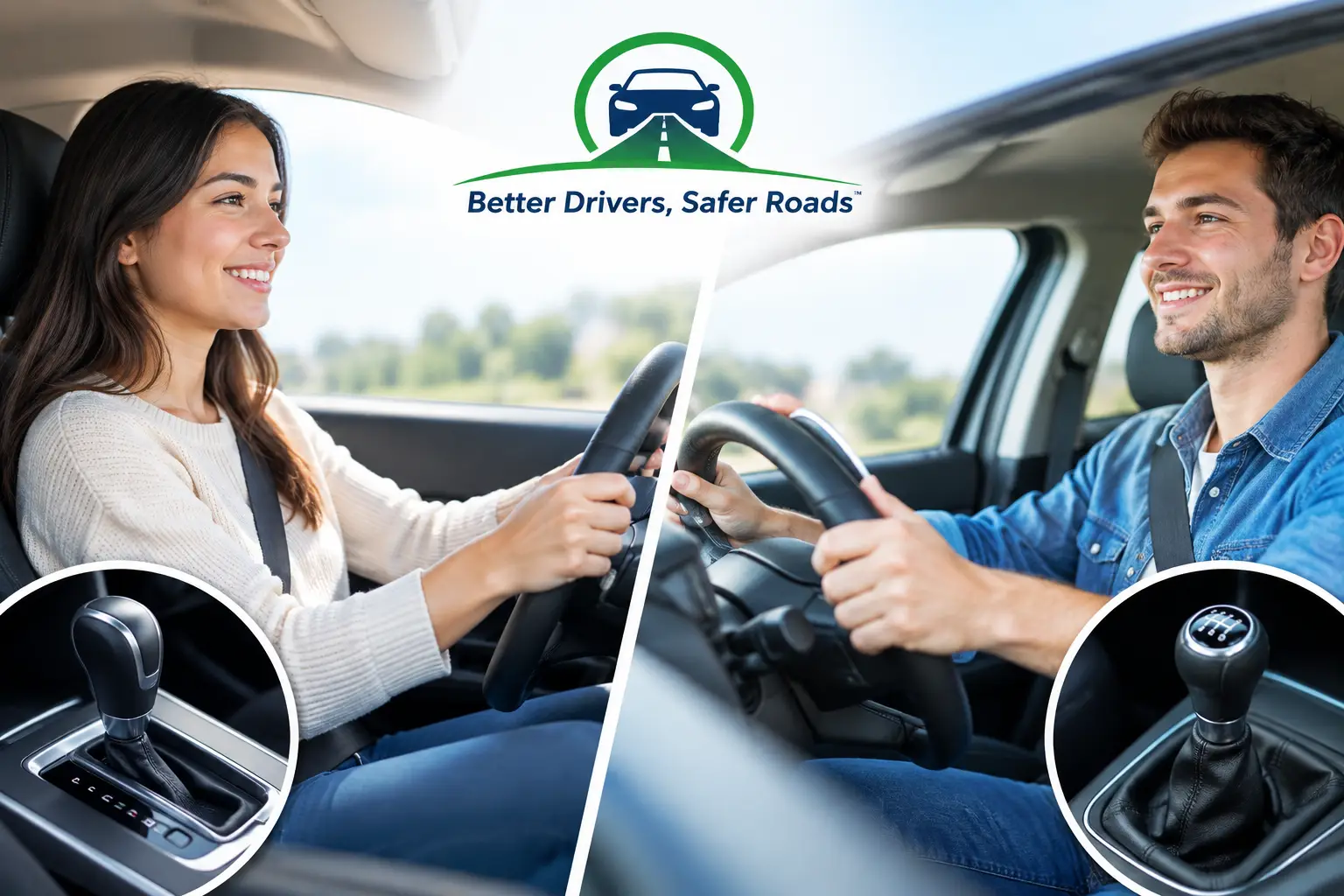
Choosing automatic versus manual driving lessons affects your license, confidence, practice options, and DMV goals. Learn which fit is right for you today.
10 Best Habits for New Drivers
The first few months behind the wheel shape the kind of driver you become. The best habits for new drivers are not flashy tricks or shortcuts. They are small, repeatable behaviors that make driving safer, calmer, and more predictable – especially when nerves, traffic, and unfamiliar roads all show up at once.
For new drivers, good habits matter more than confidence. Confidence can come and go depending on the road, the weather, or who is in the passenger seat. Habits stay with you. When your routine is solid, you are more likely to notice hazards early, make smoother decisions, and avoid the rushed mistakes that lead to close calls.
Why the best habits for new drivers matter so much
A beginner driver has to manage a lot at once: speed, lane position, mirrors, signs, signals, pedestrians, and other drivers who may not be patient. That mental load is real. Strong habits reduce that load because they turn key actions into second nature.
This is also why new drivers often improve faster with structured practice instead of random time on the road. Repeating the same safety-focused behaviors in different situations builds consistency. Whether you are a teen driver, an adult learning later in life, or someone adapting to California driving rules for the first time, consistency is what turns practice into skill.
Start every drive with a setup routine
Before the car moves, take a moment to set yourself up properly. Adjust your seat so you can reach the pedals comfortably and keep a slight bend in your arms at the wheel. Set your mirrors before shifting into gear, and make sure you can clearly see around the vehicle without leaning.
This sounds basic, but many new drivers skip it when they feel rushed. A poor seating position can affect braking distance, steering control, and visibility. If your mirrors are off by even a little, lane changes become harder and hesitation increases.
A simple pre-drive routine also helps settle nerves. When you begin each drive the same way, you start from a more focused state instead of reacting emotionally to the moment.
Keep your eyes moving, not fixed
One of the most common beginner mistakes is staring too close to the front of the car. Safe drivers scan. They look ahead, check mirrors regularly, and stay aware of the sides of the roadway instead of locking onto one point.
A good rule is to look far enough ahead to spot changes early. Brake lights, a car backing out, a pedestrian near a crosswalk, or a signal turning yellow all become easier to manage when you see them with time to spare. Mirror checks should happen often enough that you always know what is happening behind you, but not so long that your attention leaves the road ahead.
This habit is especially useful in busy Southern California traffic, where lane changes happen quickly and drivers need to anticipate rather than react late.
Leave more space than you think you need
New drivers often focus on staying in their lane and forget that following distance is one of the biggest safety tools they have. More space gives you more time. More time means better decisions.
When traffic is moving well, a steady cushion behind the car ahead helps prevent panic braking. In rain, at night, or when visibility is limited, that space should increase. If another driver cuts in front of you, the safest response is usually to ease off and rebuild the gap rather than take it personally.
There is a trade-off here. In heavy traffic, leaving space may tempt other cars to move into it. That can be frustrating, but shrinking your distance to block them usually makes the situation less safe, not more manageable.
Make signaling early a non-negotiable habit
Turn signals are not just for passing a driving test. They tell other drivers what you plan to do before you do it. For new drivers, early signaling also creates a pause – a moment to confirm your decision, check mirrors, and look over your shoulder if needed.
Late signals often come from uncertainty. A driver realizes a turn is coming up, gets anxious, and makes everything happen at once. Early signaling breaks that pattern. It gives you room to think and gives other road users time to respond.
The same principle applies in parking lots and residential areas, where speeds are lower but unpredictability is higher. Good communication still matters.
Brake and accelerate smoothly
Smooth driving is safe driving. Sudden braking and quick acceleration usually signal that a driver is not reading traffic early enough. New drivers can improve quickly by focusing on gradual pedal control and planning farther ahead.
If you see a red light in the distance, start easing off the gas early. If traffic is slowing, brake with steady pressure instead of waiting until the last second. If you are entering a main road, accelerate with purpose but not aggression.
This habit does more than improve comfort. It helps maintain traction, gives passengers confidence, and makes the vehicle easier to control. It also shows up on road tests, where abrupt inputs can make an otherwise capable driver look unprepared.
Stay calm when other drivers are impatient
Not everyone on the road will give you room to learn. Some drivers tailgate, rush through yellow lights, or act annoyed when you take an extra second to make a safe turn. One of the best habits for new drivers is learning not to absorb that pressure.
You do not need to match another driver’s impatience. If a lane change is not clear, wait. If a turn feels rushed, let the opportunity pass and take the next safe opening. The goal is not to impress the driver behind you. The goal is to make a correct, controlled decision.
This can be difficult for teens with parents in the car or adults who already feel self-conscious about learning later in life. Patience is not passive. It is disciplined decision-making under pressure.
Use every drive as focused practice
Driving gets better when practice has a purpose. Simply logging hours can help, but targeted repetition helps more. One drive might focus on left turns, another on lane changes, another on parking, and another on managing busy intersections.
This approach works because it reduces overwhelm. Instead of trying to improve everything at once, you build one skill at a time while still reinforcing the basics. It also makes it easier to notice patterns. Maybe your mirror checks are strong but your braking is late. Maybe your parking is solid but unprotected left turns still raise your stress level.
At Newport Driving School, this is one reason personalized instruction matters. Different drivers need different repetitions, and the right coaching can speed up progress without adding pressure.
Respect the rules, but also learn the flow of traffic
New drivers should absolutely know the rules of the road, but real-world driving also requires timing, observation, and judgment. For example, merging safely is not just about using a signal. It is about matching speed, checking blind spots, and recognizing whether the opening is actually workable.
The same goes for four-way stops, freeway entries, and busy parking lots. The law provides the framework. Good habits help you apply it smoothly around real people who may be distracted, impatient, or unpredictable.
This is where many beginners benefit from guided behind-the-wheel practice. Reading about a situation is helpful. Experiencing it with clear instruction is what usually builds confidence.
Put the phone fully away
Most new drivers know they should not text and drive. The problem is that distraction is not limited to texting. Looking at navigation too often, checking a notification at a red light, or reaching for a phone that buzzes can all break concentration.
The safest habit is simple: set your route before driving, place your phone out of reach, and leave it alone until you are parked. If you miss a turn, you can recover. If you miss a hazard because your attention drifted for two seconds, the consequences are much more serious.
For parents, this is one of the habits worth reinforcing consistently. For adult learners, it is often one of the fastest ways to improve decision-making because attention becomes less divided.
Review mistakes without turning them into fear
Every new driver makes mistakes. The productive question is not, “Why did I mess up again?” It is, “What happened, and what will I do differently next time?” If you braked late, missed a mirror check, or took a turn too wide, treat it as feedback.
This mindset matters because fear can become a habit too. Drivers who replay every mistake emotionally often get tighter, slower to decide, and less observant. Drivers who review mistakes calmly tend to improve faster.
A short reflection after each drive helps. Think about one thing that went well and one thing to tighten up next time. That keeps progress realistic and measurable.
The best habits for new drivers build confidence the right way
Real driving confidence does not come from feeling fearless. It comes from doing the right things often enough that safe choices become automatic. Check your setup. Scan early. Leave space. Signal with time. Drive smoothly. Ignore pressure. Practice with intention. Stay off the phone. Learn from mistakes.
If you focus on those habits, the road starts to feel less chaotic and more readable. That is when driving becomes less about getting through each trip and more about building judgment you can rely on for years.

Related Posts


Comments (0)