Driver education gives new and returning drivers the knowledge, practice, and judgment needed to meet California licensing requirements safely every day.
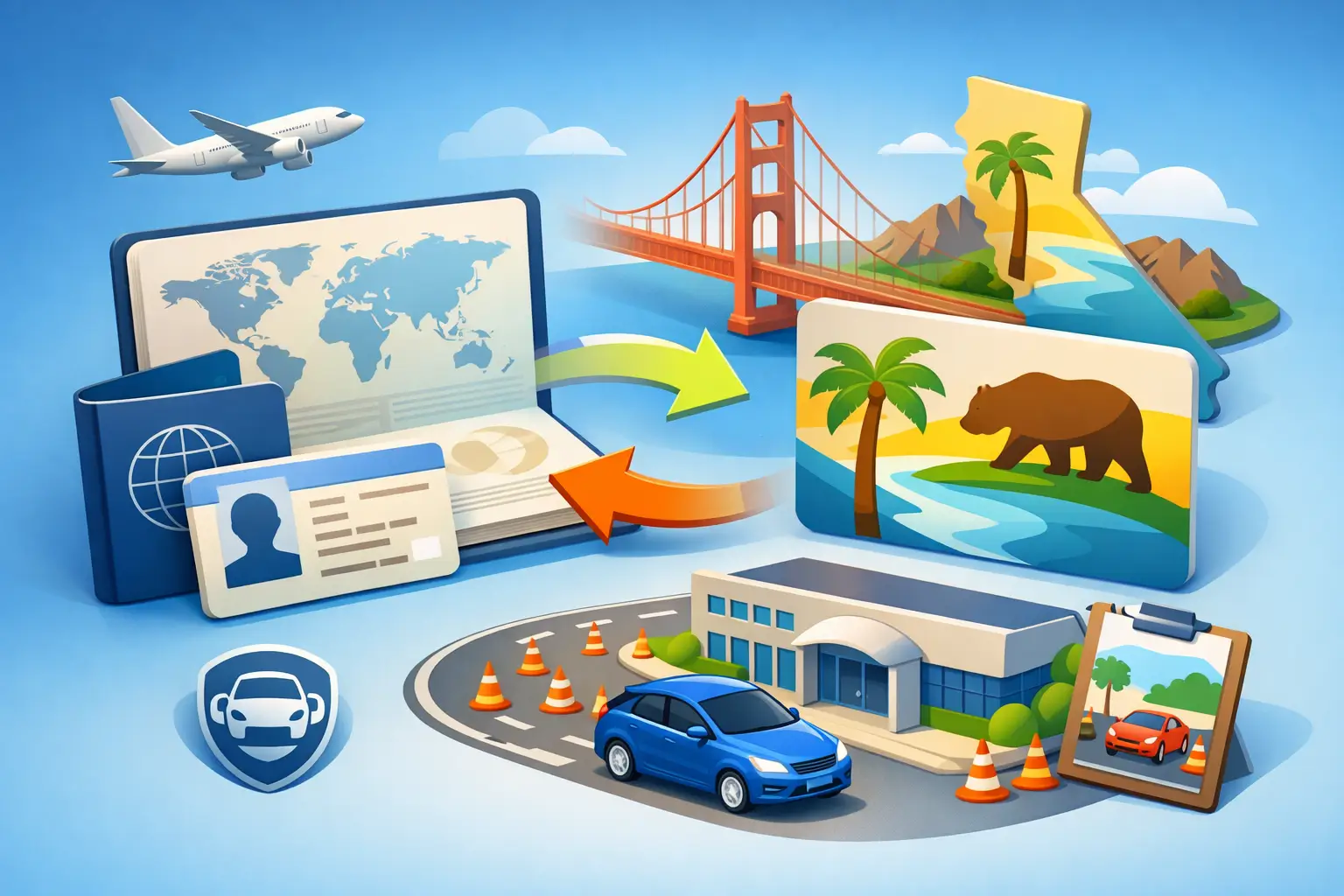
Foreign License Conversion Guide for California Drivers
A valid driver’s license from your home country can get you on the road when you first arrive in California, but it does not automatically become a California license. For an international resident, student, or newly employed professional, this foreign license conversion guide explains the practical path from driving abroad to meeting California DMV requirements with confidence.
The process is not a simple exchange. California generally requires applicants with foreign licenses to apply for a new California driver’s license, complete the required testing, and demonstrate that they can drive safely under California rules. The good news is that prior driving experience matters. With focused preparation, experienced drivers can spend less time relearning how to drive and more time adapting to the rules, habits, and test standards that are different here.
First, Know Whether You Need a California License
California treats visitors and residents differently. A visitor who is at least 18 years old may generally drive with a valid license from their home country. If that license is not written in English, carrying an International Driving Permit or a certified translation can make traffic stops, rental-car arrangements, and insurance conversations much easier. An International Driving Permit is a translation aid, not a replacement for your original foreign license.
Once you become a California resident, the expectations change. New residents are generally required to obtain a California driver’s license within 10 days of establishing residency. Residency can be created by actions such as accepting employment, paying resident tuition, registering to vote, or moving to California with the intention of living here. Because individual circumstances can be complicated, especially for students and temporary visa holders, confirm your status and current requirements directly with the DMV before relying on an exception.
A California license is also often useful beyond driving. It provides state-issued identification and can simplify everyday tasks that require an official local ID.
What Foreign License Conversion Actually Means
The phrase “conversion” can be misleading. California does not typically swap a foreign license for a California license at the counter. Instead, you apply as a new California driver, although your previous driving background may help you prepare.
Most adult applicants should expect to complete an application, provide identity and residency documents, pass a vision screening, pass a knowledge test, and pass a behind-the-wheel driving test. The DMV may review each application individually, and requirements can change. Do not assume that a driving test waiver applies simply because you have driven for years in another country.
There is a separate question for applicants who cannot provide proof of legal presence. California’s AB 60 license program may be available to eligible residents, but it has its own documentation process and is not the same as applying for a federally compliant REAL ID. The driving knowledge and safety standards remain serious in either pathway.
Documents to Prepare Before Your DMV Visit
Document issues are one of the most common causes of delay. Gather your paperwork before starting the application, and make sure the names across documents match as closely as possible. If names differ because of marriage, divorce, or a different naming order used abroad, bring the supporting records that explain the difference.
For a standard California driver’s license application, the DMV commonly asks for proof of identity, proof of California residency, and your Social Security number if you are eligible for one. Depending on your status, acceptable identity documents may include a valid foreign passport with an appropriate immigration document, a permanent resident card, an employment authorization document, or another DMV-approved record.
California residency proof often comes from documents such as a rental agreement, utility bill, bank statement, insurance policy, or employment-related record showing your name and California address. Requirements differ depending on whether you are applying for a standard license, a REAL ID, or an AB 60 license. Review the DMV’s current document list before your appointment rather than bringing documents based on someone else’s experience.
Keep your foreign license with you as well. Even when it does not eliminate testing, it helps establish your driving history and can be useful while you are transitioning.
The California Application and Testing Process
Start by completing the driver’s license application online if that option is available, then schedule a DMV appointment. An appointment reduces wait time, but it does not remove the need to bring original documentation and complete the required steps in person.
At the DMV, you can expect identity verification, a photo, a thumbprint, a vision test, and payment of the applicable fee. You will then take the knowledge test. This test is where many confident foreign drivers are surprised. The questions do not only test common sense. They test California-specific laws, signs, right-of-way rules, parking restrictions, distracted-driving laws, and safe-driving decisions.
After passing the knowledge test, you receive a permit that allows you to practice under the conditions set by the DMV. Before taking the road test, you need access to a properly registered, insured vehicle that meets DMV safety requirements. The examiner may cancel the test if the vehicle has a warning light, bald tires, broken equipment, or other safety concerns.
What the Road Test Evaluates
The California road test is not designed to see whether you can perform complicated maneuvers at high speed. It evaluates whether you are predictable, observant, legal, and safe in normal traffic.
Examiners commonly assess lane changes, turns, intersections, speed control, traffic checks, stops, backing, and parking-related skills. They also watch for habits that may have been acceptable or common in another country but create a problem in California. These include rolling through stop signs, failing to check blind spots before changing lanes, entering an intersection without enough space to clear it, or driving too slowly when conditions allow normal traffic speed.
A single serious safety error can end a test, even if the rest of the drive is strong. That is why experienced international drivers benefit from practice that focuses on California test expectations rather than simply driving around familiar streets.
The Driving Differences That Matter Most
Driving experience transfers, but road systems do not always transfer cleanly. A driver accustomed to left-side traffic may need time for lane positioning, turn patterns, and judging gaps from the opposite direction. Drivers from dense urban areas may be comfortable with congestion yet unfamiliar with wide multi-lane roads, freeway merges, and higher posted speeds.
California also places strong emphasis on complete stops, pedestrian right-of-way, bicycle awareness, and checking mirrors and blind spots. At a four-way stop, the first vehicle to arrive generally has the right-of-way, but drivers must still yield when necessary to avoid a conflict. If two vehicles arrive at the same time, the driver on the right typically goes first.
Freeway driving is another adjustment. California drivers are expected to merge at a reasonable speed, maintain a safe following distance, signal early, and move with the flow of traffic without exceeding the speed limit. Hesitation can be just as risky as rushing. A calm, deliberate lane change with mirror checks, a signal, and a shoulder check is the standard to practice.
Prepare for the Test, Not Just the Commute
Reading the California Driver’s Handbook is essential, even if you have held a license for decades. Pay close attention to topics that are easy to overlook: school zones, curb colors, railroad crossings, motorcycle lane sharing, cell phone restrictions, and rules for emergency vehicles.
Then practice in the actual driving environment you will face. A professional lesson can be especially valuable for drivers who are skilled but unfamiliar with U.S. test procedures. An instructor can identify small habits that may be difficult to notice on your own, such as braking too late, turning into the wrong lane, missing a shoulder check, or stopping too far from the limit line.
At Newport Driving School, foreign-driver training is tailored to the student’s prior experience and confidence level. Some students need a full refresher on California driving laws; others need a focused road-test preparation session and time behind the wheel in a DMV-test-ready vehicle. The right approach depends on your driving history, language comfort, and the areas that feel unfamiliar.
Common Mistakes to Avoid
Do not wait until the week of your road test to learn California rules. A foreign license may prove that you have experience, but it does not show that you know the local law. Avoid practicing only with family members who may not know current DMV scoring expectations.
Also, do not treat the road test like a performance. Examiners are looking for safe decisions, not aggressive confidence. Come to complete stops, scan actively, leave space around your vehicle, and follow instructions without rushing. If you make a minor mistake, stay composed and continue driving safely.
For drivers under 18, the process includes additional permit, education, training, and provisional-license requirements. Parents and teen drivers should plan ahead because these steps take time and cannot usually be completed in a single DMV visit.
A California license is more than a document to replace one from home. It is proof that you understand how to protect yourself, your passengers, pedestrians, cyclists, and other drivers on California roads. Give yourself enough preparation time, ask questions early, and approach the process as an adjustment in driving culture, not just a test to get through.

Related Posts
Comments (0)