Use this teen driving lesson timeline guide to plan California permit practice, professional lessons, and road-test readiness without rushing safety first.
California Intersection Safety Rules for Drivers
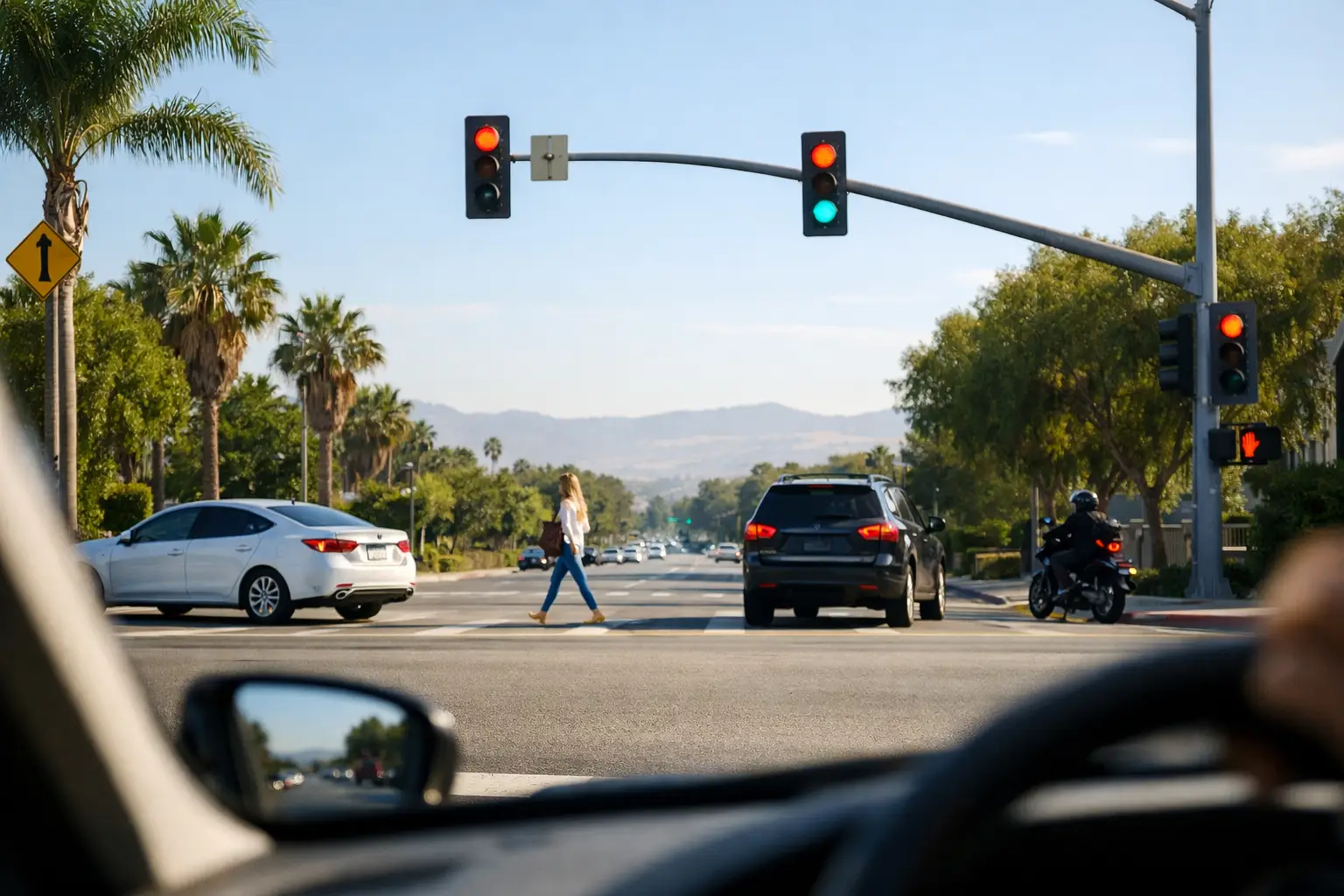
A green light does not automatically mean it is safe to go. At a busy Orange County intersection, a driver may still face a pedestrian in the crosswalk, a left-turning vehicle, a cyclist, or traffic backed up beyond the signal. California intersection safety rules are built around one simple goal: enter only when your path is clear and leave enough space to complete the maneuver safely.
For new drivers, intersections can feel like the most demanding part of every lesson. For experienced drivers, they are also where habits can become rushed or careless. The right approach is not to assume another driver will yield. It is to observe, communicate your intentions, and make decisions that prevent conflicts before they begin.
The rule behind every intersection decision
Right-of-way laws decide who should proceed first, but they do not give anyone permission to force their way into traffic. California drivers must still use reasonable care to avoid a collision, even when another road user should yield.
That distinction matters. If you have a green light but see a vehicle running a red light, waiting is safer than claiming your right-of-way. If a pedestrian has stepped into a crosswalk against the signal, you still must avoid hitting them. Safe driving means treating right-of-way as a responsibility to manage risk, not a contest to win.
Before moving through any intersection, scan left, center, and right. Look farther than the vehicle directly ahead of you. A stopped car may be hiding a pedestrian, motorcycle, bicycle, or vehicle preparing an unexpected turn.
Stop signs require a complete stop
At a stop sign, California law requires a complete stop at the limit line. If there is no limit line, stop before the crosswalk. If there is neither, stop at the point nearest the intersection where you can see approaching traffic without entering the intersection.
A rolling stop is not enough, even if the intersection appears empty. Your vehicle should come to a full stop, then you should check for cross traffic, pedestrians, and cyclists before proceeding. This is especially relevant near schools, residential streets, and parking-lot exits, where people can enter your path quickly.
Four-way stops: who goes first?
At an all-way stop, the first vehicle to arrive and stop has the right-of-way. If two vehicles arrive at approximately the same time, the driver on the left should yield to the driver on the right.
The practical challenge is that drivers do not always agree about who arrived first. Instead of accelerating to prove a point, make eye contact when possible, watch for another driver’s movement, and proceed only when the situation is clearly understood. If another driver waves you through but you cannot safely go, wait until the path is clear.
A driver turning left at a four-way stop must also yield to oncoming traffic that is going straight or turning right, unless that traffic arrived later and has not yet established the right-of-way. Patience prevents the common mistake of turning across another vehicle’s path.
Signal lights do not remove the need to look
A steady red signal means stop. You may turn right after stopping, unless a sign prohibits it, but only after yielding to pedestrians, cyclists, and vehicles that have the right-of-way. A right turn on red is optional, never required. If the view is blocked, traffic is moving quickly, or a pedestrian is approaching the crosswalk, waiting for green is often the better choice.
A green light permits you to proceed, but it does not guarantee an open intersection. Do not enter if traffic is backed up and you cannot clear the intersection before the light changes. Blocking an intersection creates danger for cross traffic, pedestrians, and emergency vehicles.
A yellow light is a warning that the signal is about to turn red. It is not an invitation to speed up. If you can stop safely before the limit line, do so. If you are too close to stop safely, continue through carefully and clear the intersection. The correct decision depends on your speed, following distance, road surface, and how close you are to the intersection.
When making a left turn on a green light without a protected arrow, yield to oncoming vehicles, pedestrians, and cyclists. You may enter the intersection to prepare for the turn when it is safe and lawful to do so, but do not turn until the opposing path is clear. Be especially cautious when an oncoming vehicle has its turn signal on. Signals can be forgotten or canceled, so wait for the vehicle to slow and begin turning before relying on it.
Pedestrians and cyclists need your full attention
Drivers must yield to pedestrians in marked and unmarked crosswalks at intersections. An unmarked crosswalk generally exists where streets meet at approximately right angles, even if no painted lines are visible. That is why scanning the corners matters before every turn.
Do not stop your vehicle in a crosswalk. It forces pedestrians to walk around your car and into traffic. When turning, check the near-side crosswalk first, then the far-side crosswalk, because a person crossing from the opposite corner can be easy to miss while you focus on vehicle traffic.
Cyclists may travel through intersections in traffic lanes, bike lanes, or other lawful positions on the roadway. Before a right turn, check mirrors and your blind spot for a cyclist continuing straight beside you. Turning across a cyclist’s path is one of the most preventable intersection crashes.
Make turns predictable and legal
Good intersection driving gives others time to understand what you are about to do. Signal continuously for at least 100 feet before turning when practical. Move into the correct lane early, reduce speed smoothly, and avoid last-second lane changes near the intersection.
For a right turn, approach as close as practical to the right edge or curb, unless signs, road markings, or a bike lane situation require a different approach. Turn into the nearest available lane unless markings direct otherwise. A wide right turn into a farther lane can cut off another driver.
For a left turn, begin from the lane nearest the center line or from the designated left-turn lane. Complete the turn into the lane nearest the center line on the road you are entering, unless signs or markings say otherwise. Starting or ending in the wrong lane is more than a test-day error. It creates unpredictable paths that other road users may not be able to anticipate.
California intersection safety rules in poor visibility
Rain, glare, darkness, and large vehicles change what a safe decision looks like. In these conditions, increase your following distance before reaching the intersection so you have time to stop smoothly. Slow down before the turn rather than braking hard while turning.
Do not pull around a vehicle that has stopped at a crosswalk or intersection unless you know why it stopped and can see the entire area clearly. It may be yielding to someone you cannot see. Likewise, a large truck can block your view of a signal, crosswalk, or oncoming lane. Wait until you have enough information to move safely.
Avoid the pressure to follow the car ahead
A frequent beginner mistake is following the vehicle ahead through an intersection without performing an independent scan. The lead driver may have a clear path, while your view is blocked by that vehicle. Build the habit of checking the signal, crosswalk, and traffic lanes for yourself before you proceed.
This is also useful during a DMV road test. Examiners look for controlled stops, appropriate gaps, correct lane position, and active observation. They are not looking for a driver who hesitates unnecessarily, but they do expect you to choose safety over pressure from drivers behind you.
Build calm habits through practice
Intersection judgment improves with repeated, focused practice. Start on lower-speed residential streets, then progress to multi-lane roads, protected and unprotected left turns, busy commercial areas, and intersections with pedestrians and cyclists. A qualified instructor can identify whether hesitation, rushed decisions, lane placement, or scanning habits are causing difficulty.
Newport Driving School has helped California learners build these skills through patient, personalized behind-the-wheel instruction since 1997. For anxious teens, adult beginners, and drivers adjusting to California road rules, structured practice can replace guesswork with a reliable routine.
At every intersection, give yourself time to see the whole picture. A safe driver does not simply react to a light or a sign. They recognize the people, vehicles, and changing conditions around it, then make the choice that lets everyone get home safely.

Related Posts
Comments (0)